 By
By People spend real money on air purifiers. They research HEPA filters, check MERV ratings, replace cartridges on schedule.
Then they sleep eight hours a night in a bedroom furnished with particle board — which is quietly undoing most of that work.
The air problem most households haven’t fixed isn’t filtration. It’s the furniture.
What Cheap Furniture Is Actually Made Of
The majority of furniture sold at accessible price points is built from MDF or particle board. Both are engineered wood products — wood fiber or chips compressed under heat and pressure, bonded together with urea-formaldehyde resin. That resin is what makes the material hold its shape. It’s also what makes it a problem.
Formaldehyde is a known human carcinogen, classified as such by the EPA and the International Agency for Research on Cancer. It doesn’t stay sealed inside the material after the furniture is assembled. It off-gases — slowly, continuously, at room temperature — and keeps doing so for two to five years after the piece was manufactured. Warm rooms and humidity push the rate higher.
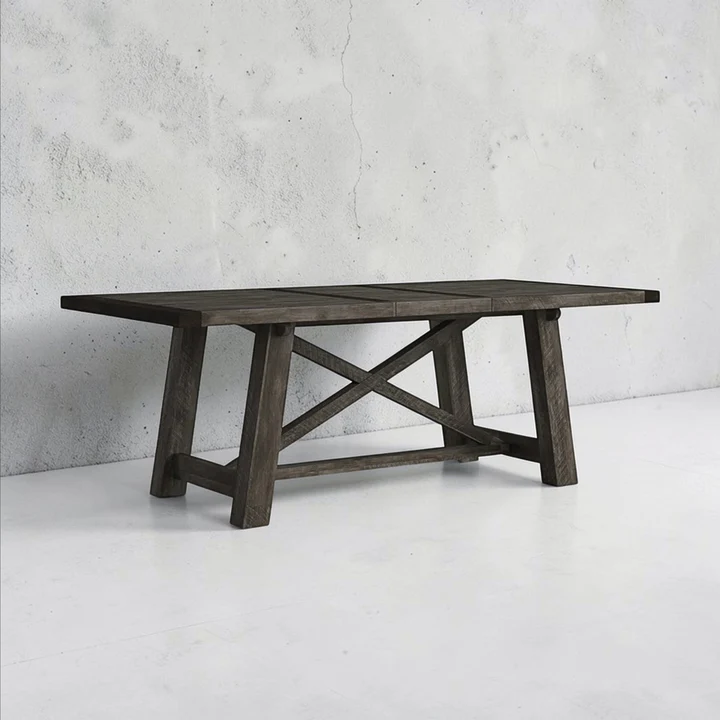
french country dining room table
Alongside formaldehyde, VOCs from synthetic lacquers and finish coatings add a second layer. Volatile organic compounds including benzene and toluene are released from the surface of the furniture itself, especially in the first months. That chemical smell that greets you when you open the box? That’s both. Most people assume it fades and the problem is gone. The smell fades. The off-gassing doesn’t.
And here’s the part the furniture industry is comfortable leaving unsaid: there’s no legal requirement to disclose any of this. A brand can label something “solid wood furniture” while the interior is entirely formaldehyde-saturated particle board. Nothing about that is illegal. Nothing requires them to tell you otherwise.
Where Your Family’s Exposure Is Highest
The risk isn’t uniform across your home. It concentrates in the rooms where your family spends the most time in enclosed conditions — and two rooms stand above the rest.
The bedroom is the most critical space. You’re there for seven to nine hours every night, in a closed room, breathing whatever the air is carrying. A particle board dresser or MDF wardrobe doesn’t sit quietly in the corner — it contributes to the air chemistry in that room continuously, through every hour you sleep.
American made bedroom furniture built from solid hardwood with clean finishes removes that contribution entirely. A non toxic bed frame made from solid oak or walnut contains no resin binders and no synthetic coatings releasing compounds overnight. For children, whose lungs and immune systems are still developing, this isn’t about being cautious. It’s about removing an unnecessary daily exposure from the room where they’re most vulnerable.
The dining room matters in a different way. The exposure window is shorter, but children sit close to the table surface — sometimes for extended periods — and they’re often at the height where heavier particles settle. A french country dining room table built from solid hardwood and finished with hardwax oil or a water-based coating brings the warmth and character the style calls for, with none of the chemical load that follows a flat-pack alternative home. The best wood for a dining table is solid hardwood — not because it looks better in photos, but because it holds its structure through joinery rather than resin.
The Two Things That Make Furniture Actually Non Toxic
Genuinely non toxic furniture comes down to two things: the core material and the finish. Both have to hold up.
Material should be solid hardwood throughout. Not “solid wood construction” — a phrase that permits MDF panel inserts inside a solid wood frame. Not “engineered wood” — particle board with a more palatable name. Solid hardwood is timber milled directly, kiln-dried to the correct moisture content, and assembled using traditional joinery — mortise-and-tenon joints, dovetail drawer boxes, proper hardware. It needs no chemical binder to stay together because the wood itself carries the structural load.
Finish should be water-based or hardwax oil. These are the cleanest options available in furniture manufacturing. Hardwax oil penetrates the surface rather than sitting on top of it as a film, which means it won’t crack, trap compounds, or peel over years of use. It also ages better than lacquer — spot-repairable, refinishable, and stable over decades.
Formaldehyde free furniture addresses the resin problem. Non toxic furniture addresses both the resin and the finish. A piece can skip urea-formaldehyde entirely and still carry a VOC-heavy lacquer that defeats the purpose. The standard has to cover both.
The quickest filter when evaluating any brand: ask directly what the core material is and what’s in the finish. Brands using clean materials answer this without hesitation — because it’s one of the best things about their product. Brands that deflect or go vague are almost always doing so for a reason.
The Honest Case for Making the Switch
Most households have already handled the obvious air quality concerns. The purifier is running. The windows get opened. The cleaning products are cleaner.
The furniture sitting in the bedroom and dining room is the variable most people never touched — because nobody told them it was a variable at all.
Non toxic furniture built from solid hardwood fixes that quietly and permanently. It doesn’t need replacing in three years. It doesn’t degrade and release more compounds as it ages. It sits in your home getting better looking with time, contributing nothing harmful to the air around it.
You make the switch once. Then you genuinely stop thinking about it — which is exactly the point.